
I truly believe that in the near future, educators and parents will have a responsibility to teach media literacy, especially how to evaluate misinformation. The misinformation education tools we explored in Module 3 could help build that foundation. Going through these exercises taught me something valuable: recognizing misinformation is one thing, but understanding how someone might manipulate others is something entirely different.
RumorGuard
When I first opened RumorGuard, its purpose was immediately clear. Rather than simply fact-checking claims, it teaches users how to investigate them for themselves. Before looking at any stories, I explored “The Factors,” which outlines RumorGuard’s five criteria for evaluating information: authenticity, source, evidence, context, and reasoning.
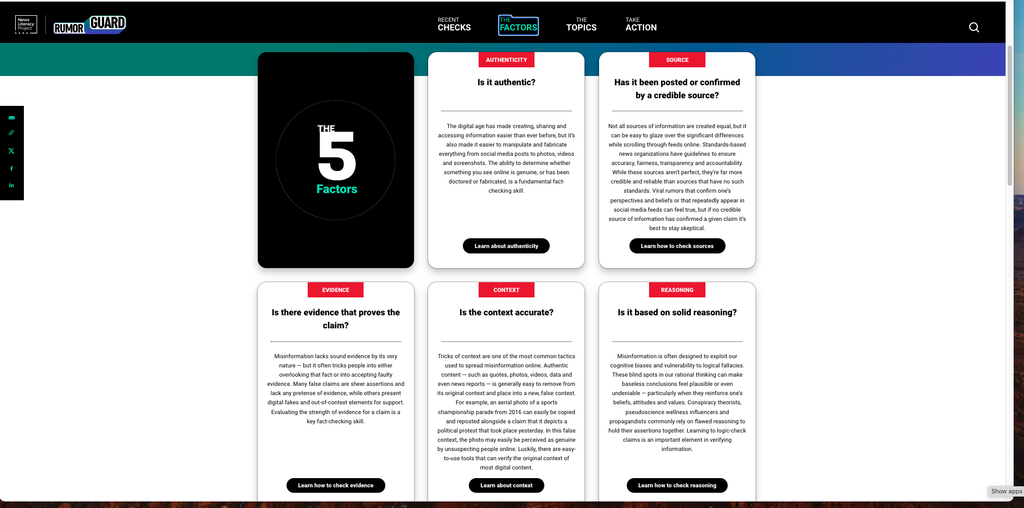
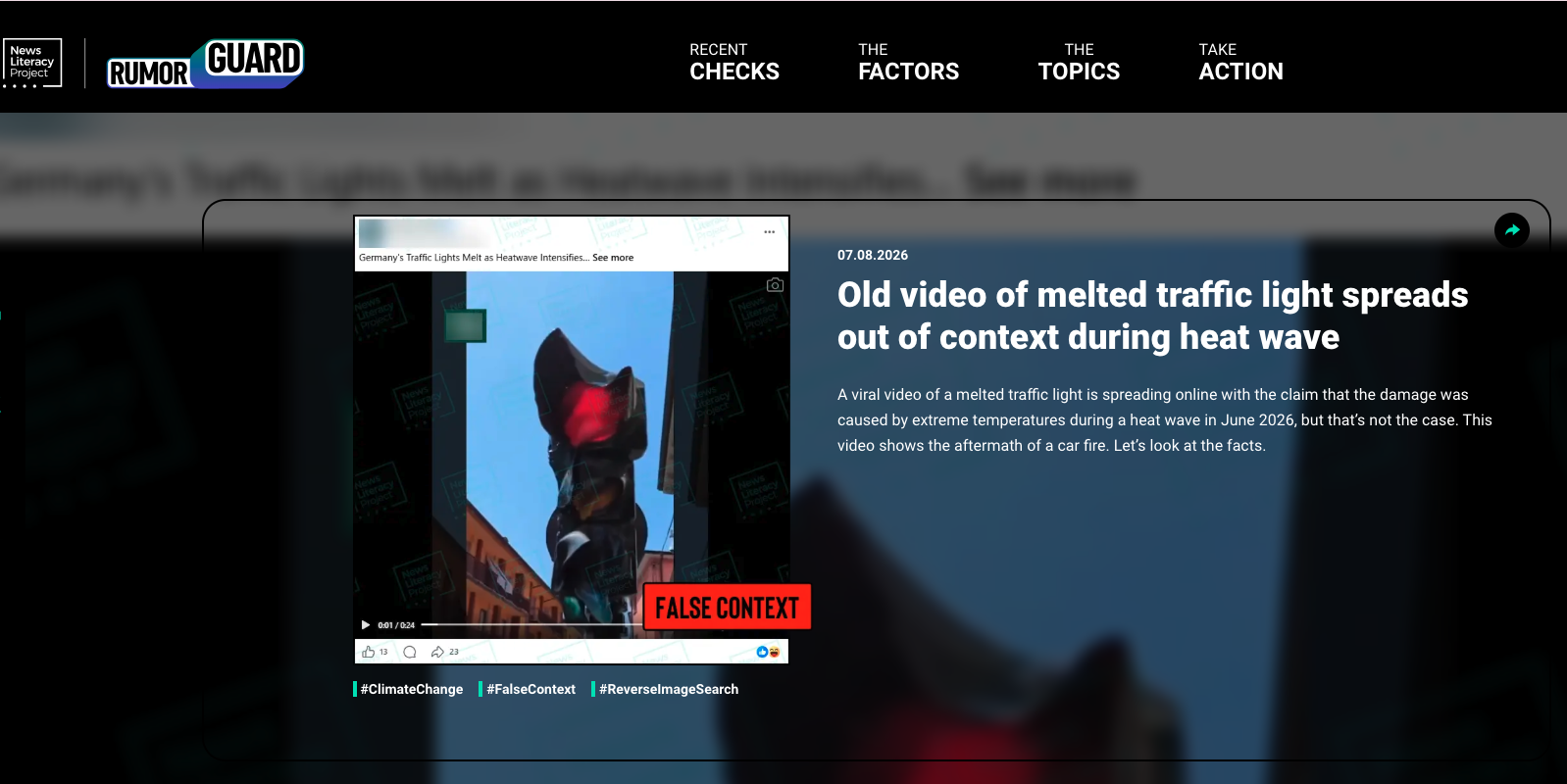
These are questions I already ask when I encounter suspicious content online, but RumorGuard helped me think about them more systematically. One example that stood out was a story claiming a traffic light had melted during a European heat wave. My first reaction was to question whether extreme heat could actually melt a traffic light. RumorGuard shifted my focus to different questions: Where did the image come from? Was there evidence connecting the damage to the heat wave? Was the image being presented in its original context?
The answer was no. The traffic light had actually been damaged by a nearby car fire, and an old video was recirculated during the heat wave. What made this example interesting was that the image itself was authentic. The misinformation came entirely from the false context surrounding it. It showed me that a real photo can still be misleading.
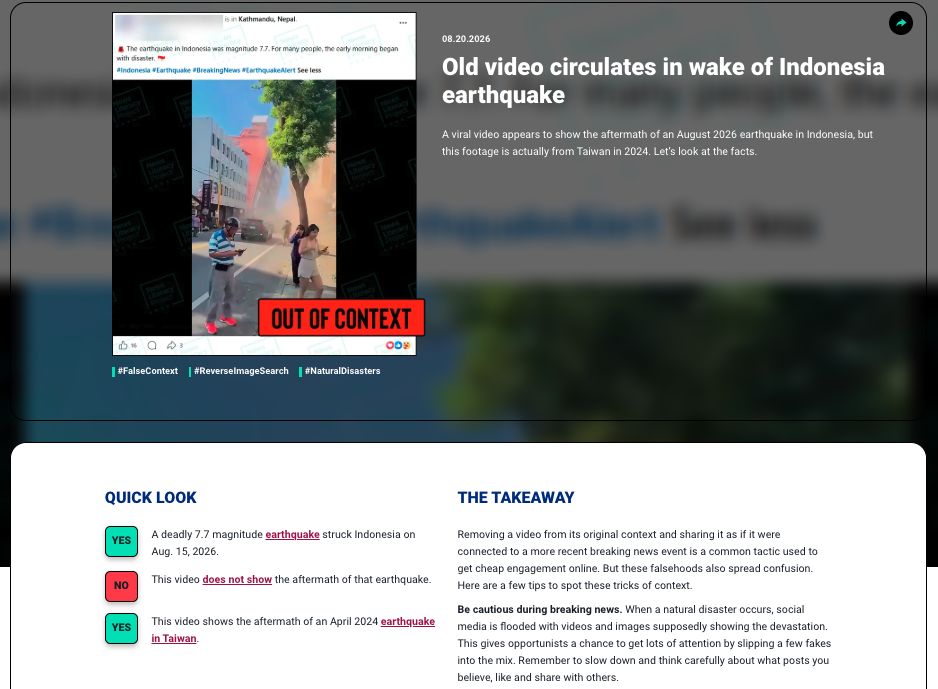
Another example involved a video that was shared as footage from a 2026 earthquake in Indonesia. In reality, it was taken in Taiwan in 2024. Again, the content wasn’t manipulated. Instead, changing the time and place completely altered how viewers interpreted what they were seeing.
Overall, I think RumorGuard is highly effective as an educational tool because it emphasizes a repeatable verification process rather than simply labeling claims as true or false. Its biggest limitation is that while it can teach people how to investigate information, it cannot force them to stop and investigate before sharing it.
Bad News
For the second activity, I chose the game Bad News. What immediately caught my attention was its role reversal. Instead of teaching users how to defend themselves against misinformation, the game puts them in the position of someone creating it.
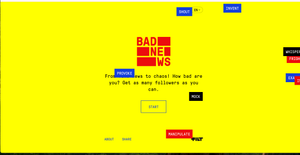

Bad News reverses the usual media-literacy exercise by putting the player in the role of a misinformation creator and introducing six manipulation techniques.
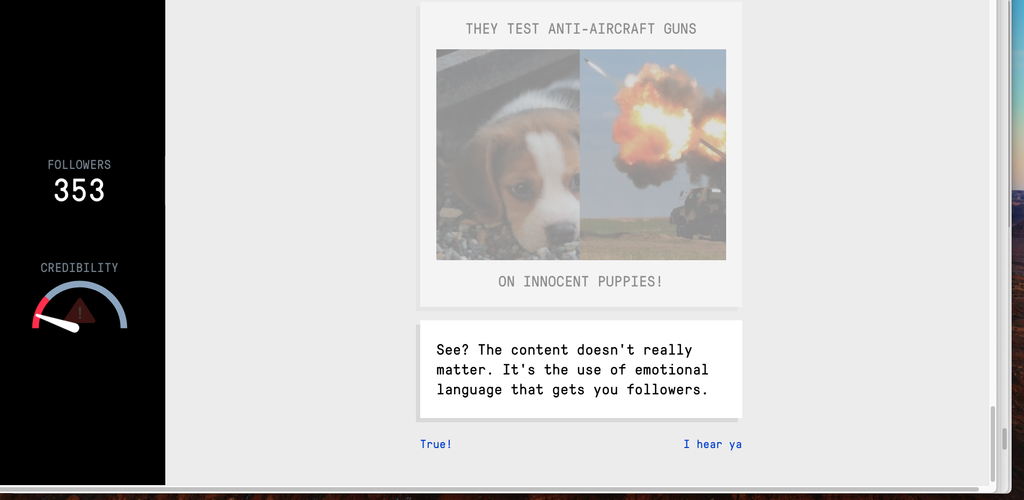
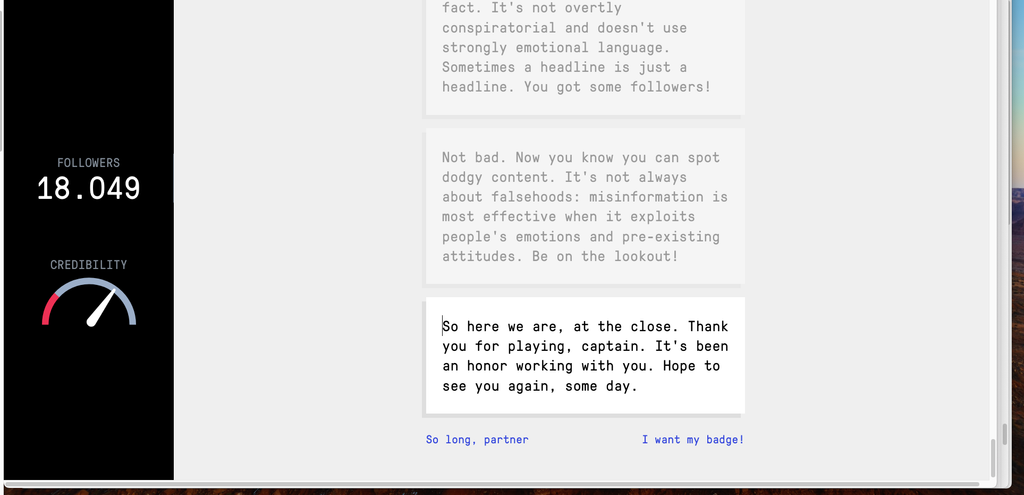
I started by building a fake news organization and quickly learned the six techniques the game uses to spread misinformation: impersonation, emotion, polarization, conspiracy, discrediting, and trolling. The lesson became obvious almost immediately. A straightforward headline about the president visiting Luxembourg attracted little attention, while emotionally charged content generated far more engagement. The game repeatedly demonstrated that emotional reactions often matter more than the actual information being shared.
The most memorable section involved spreading conspiracy theories. A ridiculous claim about juice boxes containing Valium failed because it was too disconnected from reality. The game explained that successful conspiracies usually begin with something plausible before gradually expanding into more extreme claims. That insight was much more interesting than simply saying people believe outrageous things.
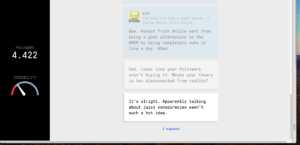
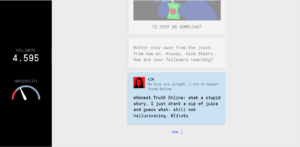
The game demonstrates how conspiracy narratives become more persuasive when they begin with something plausible and gradually introduce suspicion and increasingly extreme claims.
Later, I turned a fictional plane disappearance into a national scandal by suggesting a CIA cover-up, amplifying claims with bots, using doctored images, and framing cautious official responses as evidence of guilt. What fascinated me most was not any individual tactic, but how all of them worked together. By the end, I better understood how misinformation gains momentum and spreads online.
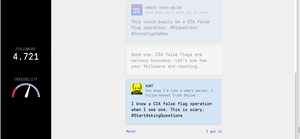
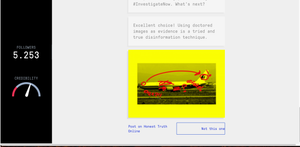
A fictional plane disappearance becomes a conspiracy through suggestions of a CIA cover-up, doctored evidence, artificial amplification, and suspicion toward official explanations.
Conclusion
Ultimately, RumorGuard taught me defensive media literacy: how to evaluate and investigate claims. Bad News taught me offensive media literacy: how manipulators capture attention, exploit emotions, and guide people toward misleading conclusions.
Before these exercises, I viewed media literacy mostly as determining whether information was true or false. These tools complicated that view. A real photo can be misleading when stripped of context. A false claim may fail if it lacks emotional appeal. A minor story can appear important when bots manufacture engagement. And conspiracy theories often succeed by mixing real information with suspicion and emotion.
If we want people to recognize misinformation, fact-checking alone isn’t enough. We also need to understand why misleading information is created, how it spreads, and what makes it persuasive in the first place.
