
Most of us have heard the old saying,“all that glitters isn’t gold.” In today’s digital world, that lesson may be more important than ever. Social media platforms are filled with professional-looking videos, polished graphics, attention-grabbing headlines, and content creators who sound confident and authoritative. However, appearance alone does not tell us whether information is true.
That reality is what inspired this project.
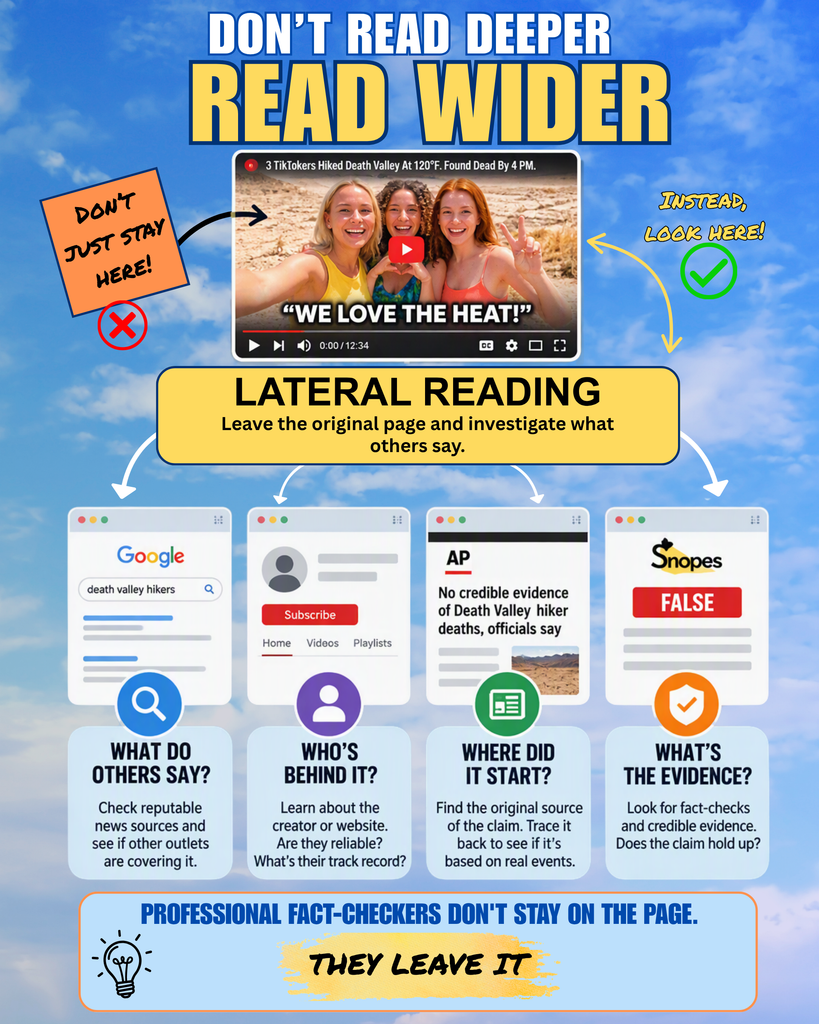
The goal of this graphic series is to teach lateral reading, a technique used by professional fact-checkers and researchers to evaluate online information. Instead of judging a claim based only on the page, video, or post where you found it, lateral reading encourages people to leave the page and investigate what other sources say before deciding whether a claim is trustworthy. Research by Sam Wineburg and Sarah McGrew found that professional fact-checkers were significantly better at evaluating online information because they left questionable websites, opened additional tabs, searched for outside information, and investigated sources rather than simply examining the original page.
Why I Chose This Topic
I chose this topic because misinformation has become increasingly more widespread and difficult to identify. Modern technology allows content creators to produce videos, images, graphics, and stories that appear highly professional, even when the information they contain is inaccurate or completely fabricated.
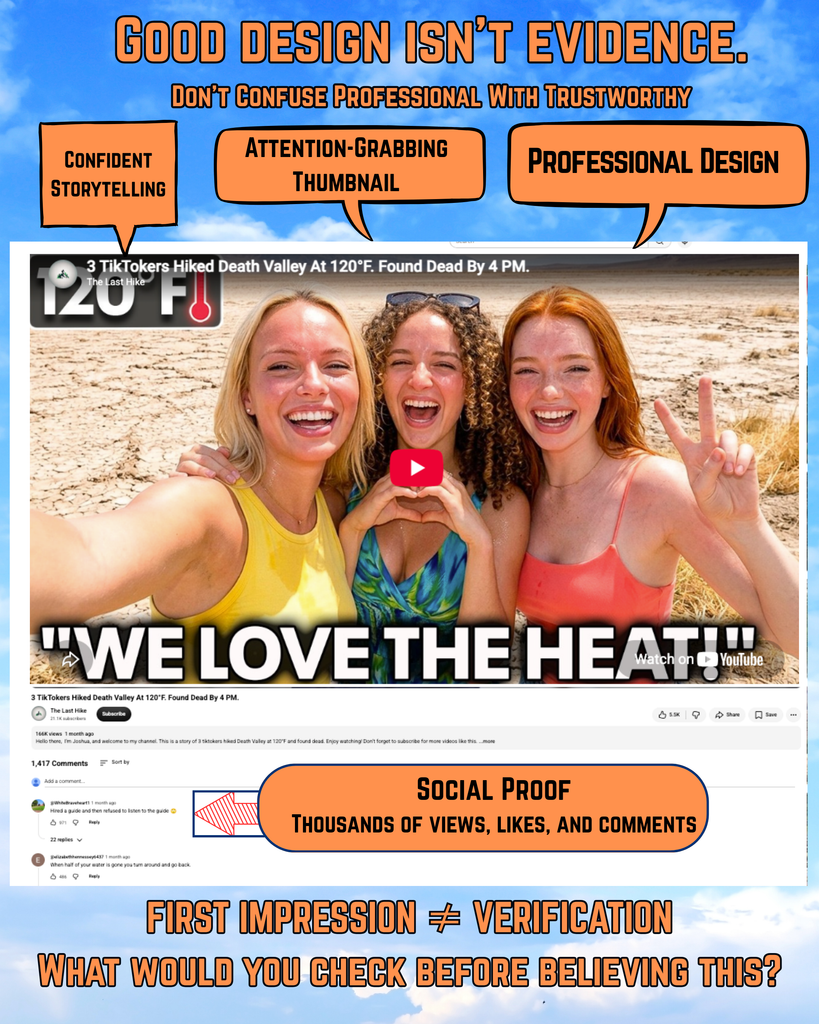
During one of my course assignments, I encountered a YouTube video claiming that three TikTok influencers died while hiking in Death Valley during extreme heat. At first glance, the story seemed believable. The video featured a professional-looking presentation, confident narration complete with a narrator, and thousands of views and comments. Like many viewers, I initially assumed the story was legitimate.
However, once I began searching for additional information, things started to fall apart.
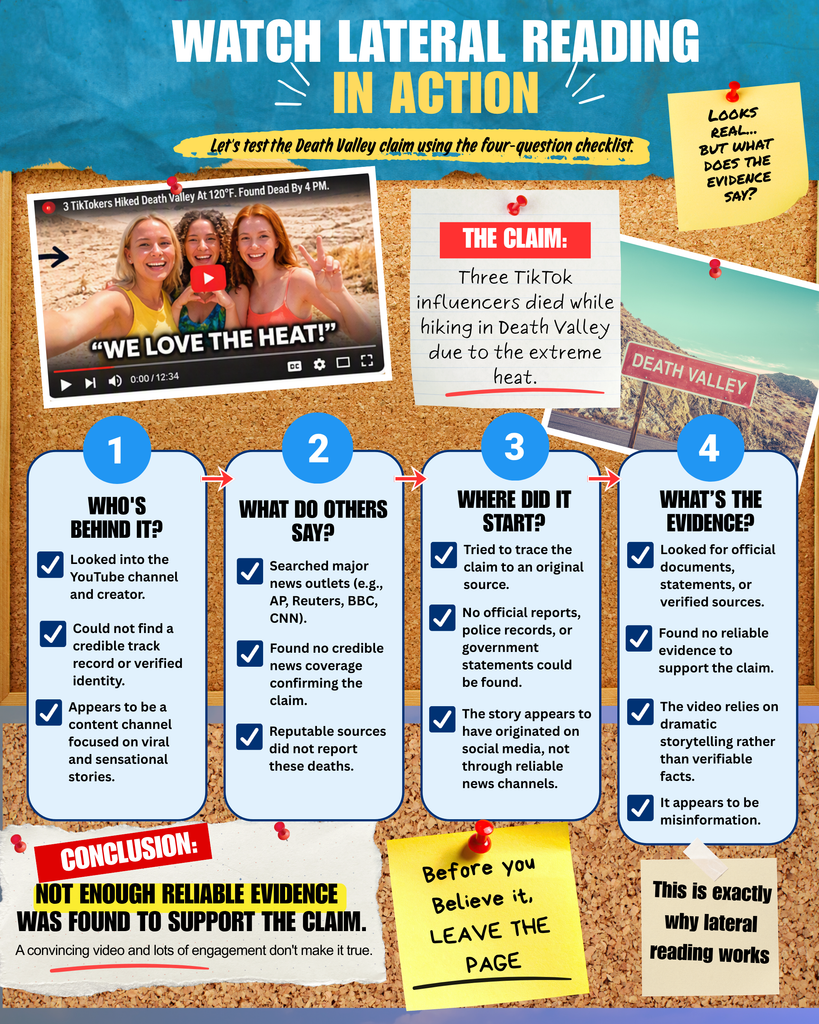
I could not find credible reporting from major news organizations, official statements, or reliable evidence confirming the events described in the video. The experience became one of the most memorable examples of misinformation that I encountered throughout the semester. It reinforced an important lesson that credibility comes from verification, not presentation.
The YouTube video that inspired this project. Although the video appears credible at first glance due to its professional presentation and engagement metrics, lateral reading revealed a lack of reliable evidence supporting the claim
Why Lateral Reading Works
Many people evaluate information by reading more closely or studying the original source in greater detail. Researchers have found that this approach is often ineffective online. In studies comparing historians, students, and professional fact-checkers, fact-checkers consistently performed better because they left the page and investigated information elsewhere. This approach became known as lateral reading.
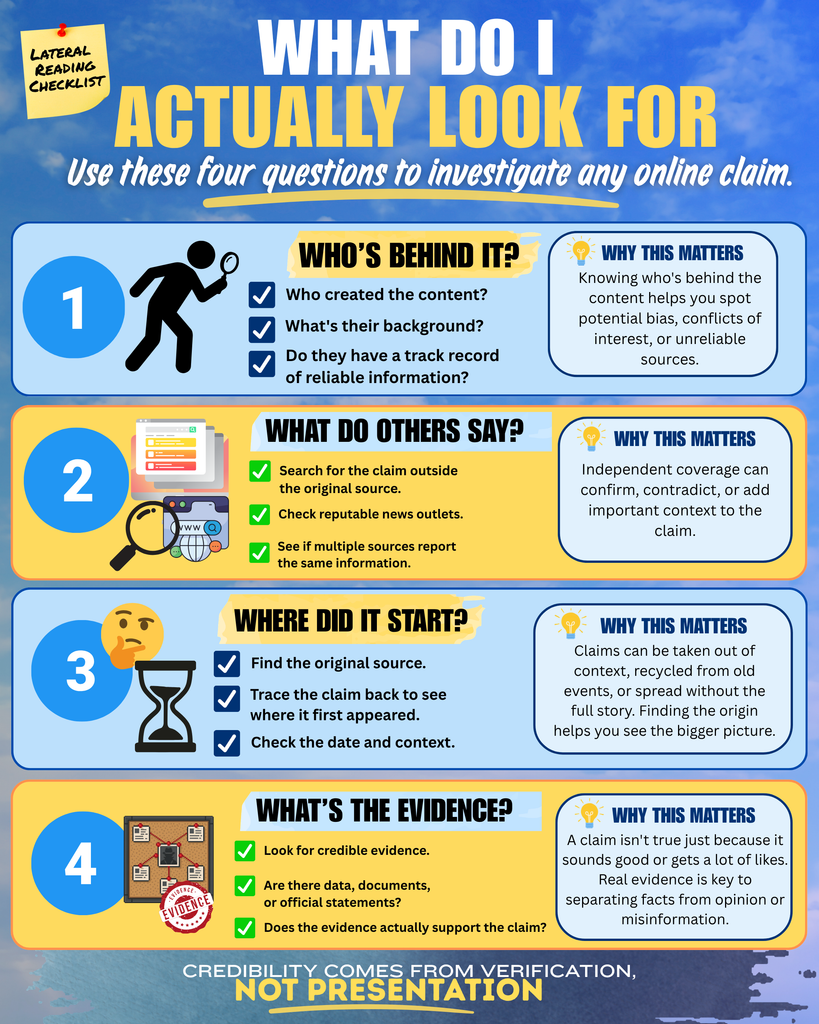
Lateral reading encourages people to pause and investigate information before accepting it as true. Rather than judging a claim solely on its appearance, readers examine things much more closely. Some of the things people look into would be who is behind the content, what other sources are reporting it, where the claim originated, and whether credible evidence supports it.
This process can help people move beyond first impressions and evaluate information more carefully. In an online world filled with professional-looking content, this practice can provide students with a vital skill set to help them distinguish credible information from misinformation.
Why Misinformation Spreads So Easily
One reason misinformation can be so persuasive is that it often contains characteristics that encourage sharing and belief. According to researchers writing for What makes an election rumor go viral? Look at these 10 factors, rumors gain traction when they create uncertainty, contain emotionally compelling claims, appear to offer convincing evidence, and are repeatedly shared across social networks. Familiarity and repetition can make information feel believable even when it lacks supporting evidence.
The Death Valley video showcases several of these characteristics. It presents a dramatic story, uses compelling visuals, generates significant engagement, and appears credible at first glance. Without further investigation, many viewers could easily accept it as true.
The Purpose of This Graphic Series
My target audience is young adults and college students who regularly encounter information while scrolling through platforms such as YouTube, Instagram, TikTok, X, and Facebook. Rather than teaching people about one specific false claim, I wanted to teach a practical skill that can be applied repeatedly whenever questionable information appears online.
The four graphics in this project follow a simple progression:
- Question first impressions.
- Learn the concept of lateral reading.
- Understand the four key questions to ask.
- Watch the process being applied to a real-world example.
The underlying message is:
Credibility comes from verification, not presentation.
Before believing or sharing information online, leave the page. Investigate the source. Look for better coverage. Trace claims to their origin. Search for evidence.
In a world where anyone can create professional-looking content, lateral reading is one of the most valuable skills we can develop as media consumers.
Take a look at the graphic series below and consider how lateral reading might help students and social media users evaluate online information more effectively.
Lateral Reading Graphic Series. This four-part infographic introduces the concept of lateral reading, explains why first impressions can be misleading online, outlines four key verification questions, and demonstrates the process using a real-world example.
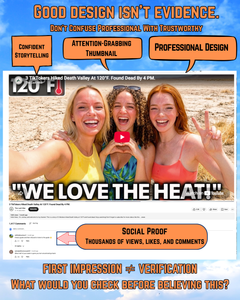
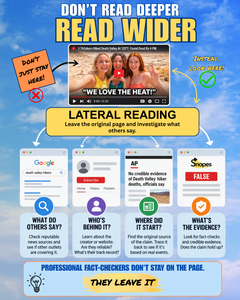
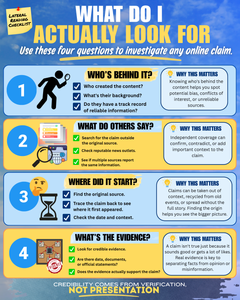
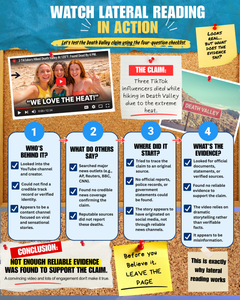
The following graphic series was designed to teach the principles of lateral reading through a step-by-step visual process that moves from recognizing misinformation to actively verifying claims.

References
Donald, B. (2016, November 22). Stanford researchers find students have trouble judging the credibility of information online | Stanford Graduate School of Education. Home | Stanford Graduate School of Education. https://ed.stanford.edu/news/stanford-researchers-find-students-have-trouble-judging-credibility-information-online
Gabriel, V. (2021, February 23). Lateral reading: College students learn to critically evaluate internet sources in an online course | HKS Misinformation Review. Misinformation Review; http://HKSMisinformationReview. https://misinforeview.hks.harvard.edu/article/lateral-reading-college-students-learn-to-critically-evaluate-internet-sources-in-an-online-course/
Hughes, S. (2023, July 20). Lateral reading: The best media literacy tip to vet credible sources – Poynter. Poynter; https://www.poynter.org/fact-checking/media-literacy/2023/lateral-reading-the-best-media-literacy-tip-to-vet-credible-sources/
Starbird, K., Caulfield, M., Diresta, R., & Grass, M. (2022, October 25). What makes an election rumor go viral? Look at these 10 factors. Niemanlab.Org/; Nieman Lab. https://www.niemanlab.org/2022/10/election-rumors-gone-viral/
Supiano, B. (2019, April 25). Students Fall for Misinformation Online. Is Teaching Them to Read Like Fact Checkers the Solution? Chronicle.Com. https://www.chronicle.com/article/students-fall-for-misinformation-online-is-teaching-them-to-read-like-fact-checkers-the-solution/
The Last Hike. (2026, August 6). 3 TikTokers Hiked Death Valley At 120°F. Found Dead By 4 PM. YouTube. https://www.youtube.com/watch?v=jOlBk–i8Ns